I was recently browsing websites for common software used in shared hosting providers (like cPanel, WHMCS, Imunify360), and noticed cPanel and WHMCS were both “parts of the WebPros Family”.
I then went to the WebPros website, and saw “AI @ WebPros” link in the header. Looks interesting, since I was thinking “why would shared hosting providers use AI!?”. So I clicked the link, and saw this (!):
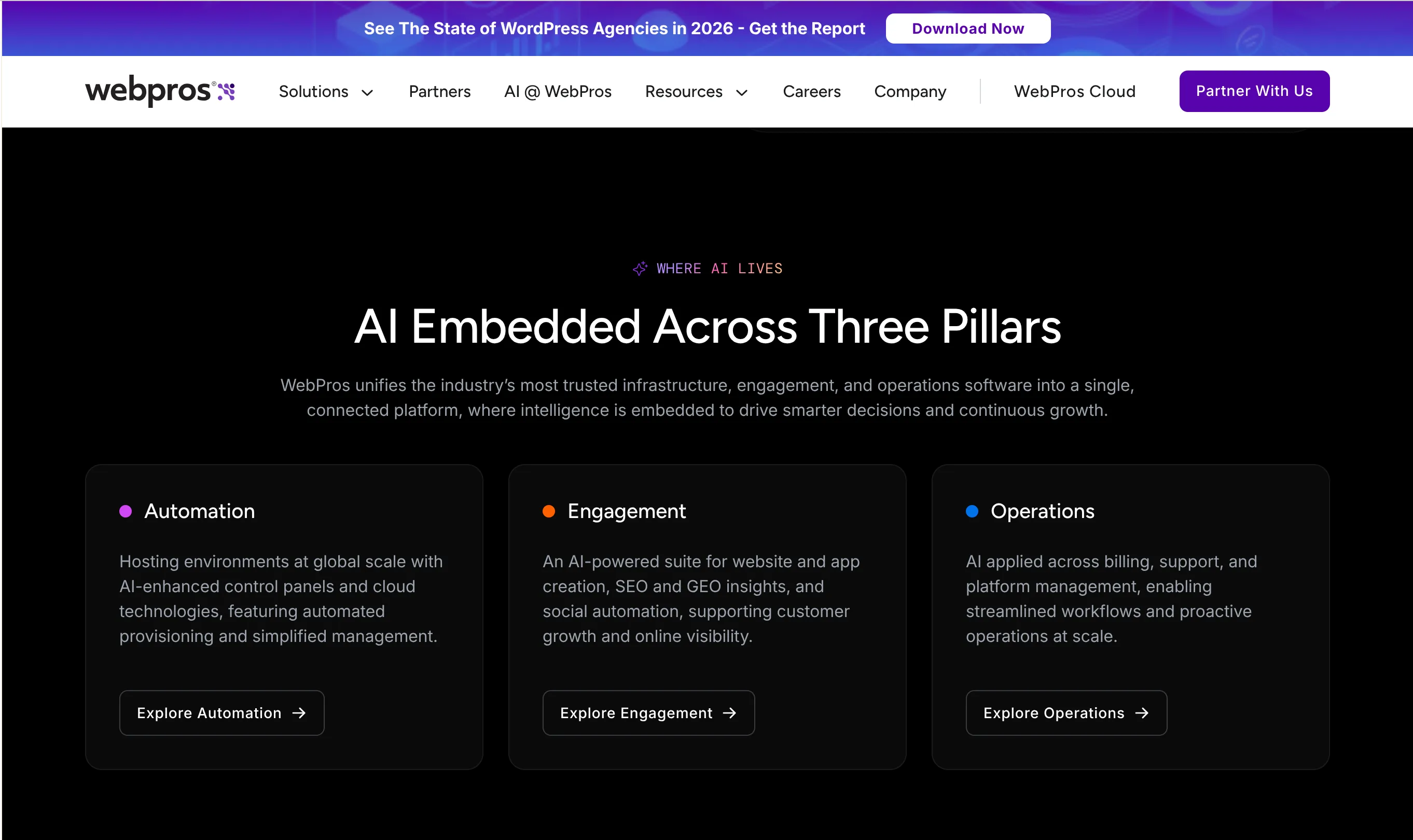
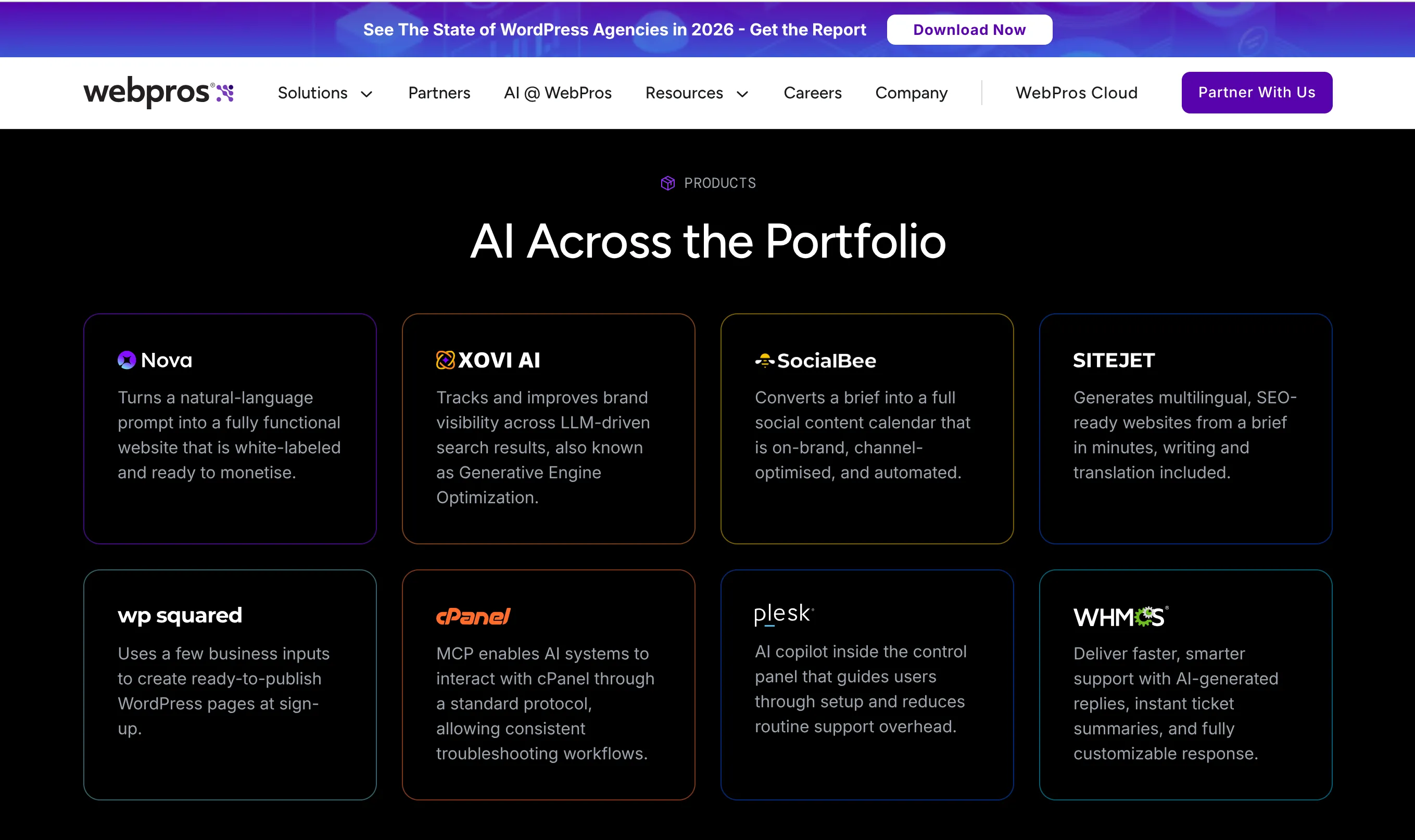
Then I was thinking:
- “Why would a shared hosting provider use AI!? I already saw what’s happening with GitHub’s uptime” (But GitHub’s uptime issues seem to be since Microsoft’s acquistion, maybe it’s not correlated with AI after all)
- “Maybe hosting providers just want their infrastructure to be stable and calm!? Or hosting providers’ customers?”
- “Also, what if that AI would wrongfully close customers’ WHMCS tickets?” (I already experienced that on ferronweb/ferron, with an AI agent wrongfully closing some issues when I wanted to do GitHub issue clean up)
At this point, I was thinking:
If I were a hosting provider, I would rather go with FOSSBilling + HestiaCP (or some other similar, maybe more compatible, open source web hosting stack)…
Maybe some vibe-hosting providers would come thanks to WebPros? 😅
About shared hosting and AI
I believe shared hosting services have become a commodity - people are looking for cheap hosting services, and the market is racing to the bottom when it comes to the price. Many businesses are looking for hosting their web presence, and many of those have non-technical executives; they’re looking for somewhere easy to set up.
And that’s where hosting providers come in: they offer CMS auto-installers (common one would be Softaculous), website security (can be via Imunify360), a management panel (popular choice would be cPanel, which can be also used to manage custom-domain email accounts for businesses; although I think they would use the CMS admin panel more frequently), and so on.
These people want stable, calm hosting for their website that just works. Now imagine if AI would wrongfully close their support tickets on the billing panel (customer frustration!), AI accidentally executing rm -rf or breaking WordPress installations by editing (and breaking) some critical PHP files (website instability!), and some other incidents.
I have experienced that once when doing a vibe-coding experiment for recreating my web server project’s website: when I tried “North Mini Code” free hosted model with OpenCode, I saw AI behaving unexpectedly, and I even saw one rm command that would wipe my other projects (!) (good news: OpenCode guardrails caught this and asked me for permission, and I denied that, saving my projects from being wiped out by AI 😌).
Now imagine what if AI wiped out WordPress installation or a production database (I saw some incidents few times)… I read these incidents would happen if AI (which is probabilistic by design) would be given deterministic authority and zero guardrails. And these incidents happened with well-known AI agents (Replit Agent, Cursor agent + Claude). Now imagine what would happen with lesser-known (and less battle-tested) AI agents… 🥲
Vibe-hosting providers…
Now I have talked about AI incidents, imagine if there would be someone not-very-technical who wants to start a business, and chooses shared hosting… Then they would be hooked up by AI features in tools for running said business, then they would start a new hosting provider (vibe-hosting? 😅), and promote it.
Then customers come as a result of promotion, and they order these hosting services. And this is the point where the problems I mentioned before (wrongfully closes tickets, broken WordPress or deleted production database) happen. Customers would be unhappy and switch to a different hosting provider; and they won’t get back the time wasted on unstable hosting services. And the hosting provider then loses reputation, and later on they’re forced to close the business.
Also, if AI would be confidently wrong and say the seahorse emoji is ”🐉”, ”🫏” or even ”🫵” (!), would you trust it to run your web hosting service? Since AIs can be confidently wrong (and end up running destructive commands and cause revenue loss)…
At this point, I have thoughts about starting a blog about seahorses or seahorse emojis…
“AI-powered” NO!
Many companies nowadays are following trends, one of which is related to AI/LLMs. And I saw this includes web hosting software vendors. However, those wanting to put their website online want a stable, calm place to host the website on. Notice how this doesn’t include AI? And as I said before, there are cases where AI would actually contradict the promise.
Though in theory AI could be used to automate tasks at hosting companies (like debugging production incidents, which would take a lot of time for tired engineers), in practice the limitations (like being confidently wrong, which could lead to website breakage) could make customers lose trust in them. And trust in hosting companies is a very important factor.
About specific AI applications
Now I’m done with the theory, let me check the practical application as listed on AI-related landing page:
Nova
Turns a natural-language prompt into a fully functional website that is white-labeled and ready to monetise.
What if that could be used to create low-effort “AI slop” websites that would pollute the web and search results?
XOVI AI
Tracks and improves brand visibility across LLM-driven search results, also known as Generative Engine Optimization.
AIs citing AI slop, and then being trained with AI slop content would lead to model collapse (if the AI labs couldn’t filter it out).
SocialBee
Converts a brief into a full social content calendar that is on-brand, channel-optimised, and automated.
Why use AI for writing social media posts!? I saw quite few scandals related to AI-generated posts, and @levelsio (in)famously blocking low-effort AI-generated replies.
SITEJET
Generates multilingual, SEO-ready websites from a brief in minutes, writing and translation included.
wp squared
Uses a few business inputs to create ready-to-publish WordPress pages at sign-up.
Same “AI slop” problem as the first application (Nova).
cPanel
MCP enables AI systems to interact with cPanel through a standard protocol, allowing consistent troubleshooting workflows.
Ah, I admit - I have also used AI systems for troubleshooting the cause (even vibe-made a test setup around that)…
Wait… were I vibe-coding? 😅
However, there would be a configuration drift problem… And then, destructive commands (looking at you, sudo rm -rf / --no-preserve-root!)… I think the guardrails should block attempts to reconfigure or manage, or run arbitrary commands on the server.
At least I haven’t used the test setup with a production server (destructive commands would be a disaster, but at least the VPS provider I use, OVH, does automatic backups I can restore from in case of such disaster)…
plesk
AI copilot inside the control panel that guides users through setup and reduces routine support overhead.
But somebody has to review that AI copilot! What if “hallucinated” information appeared (I experienced several times when trying to let AI write some documentation)?
WHMCS
Deliver faster, smarter support with AI-generated replies, instant ticket summaries, and fully customizable response.
As before, AI falsely closing support tickets. And many have enough with “AI slop”. Maybe the customers could just ask whatever AI chatbot they have and got just-as-good results…
What would I do for my web server project
For my web server project (Ferron 3 beta to be exact, which is in development), I wouldn’t forcibly integrate AI, since the target audience (sysadmins) would want calm operations instead of AI deleting their production database.
If I wanted an AI integration, I would at most include an MCP server (so that users/customers could bring their own, hopefully battle-tested, AI agents). I don’t want to “burn” money for AI APIs, only to lose peoples’ trust because of AI agent incidents. This is also why I don’t want to maintain an AI agent integrated in that software.
For observability (or logging, monitoring), there’s no MCP integration. Operators can use observability backends via OTLP, which can include own MCP servers (like Grafana MCP for the LGTM stack). And they could bring their own AI agents with that MCP server enabled. Or browse Grafana dashboards or metric drilldowns. Or just grep log files (yes, even like this, Ferron 3 would make it easier to debug with trace ID anchors, especially with high-concurrency, intermittent failures). That’s operators’ choice.
For configuration, it’s primarily via configuration files. There’s admin API, though there’s no config edit endpoint (just config reload). I made this intentionally to make configuration drift harder (also, config drift detection metrics).
Conclusion
I see that many companies follow AI hype, including hosting companies and software vendors too. However, keep in mind that customers (and hosting companies) expect stable, calm infrastructure, and AI can contradict that.
This post wasn’t against AI in general or even integrating AI in web hosting workflows (in fact, I think Grafana MCP would make it easier for AI SRE agents to debug infrastructure, and AI SRE agent can offload the work of tired DevOps engineers), it was against AI hype that can lead to disregarding the original goals, including stability and calm operations. And it would be a warning against the rise of “vibe-hosting” providers that focus too much on the profit and not in operational stability.